

On September 4, 2026, researchers from IBM, AMD and Basque Quantum (BasQ) posted a preprint introducing Lindblad Multiproduct Formulas, a quantum error-mitigation technique built on classical tensor networks. Jay Gambetta of IBM described the work in early October as an example of classical and quantum computers reaching results that are beyond either on its own.
What the paper reports
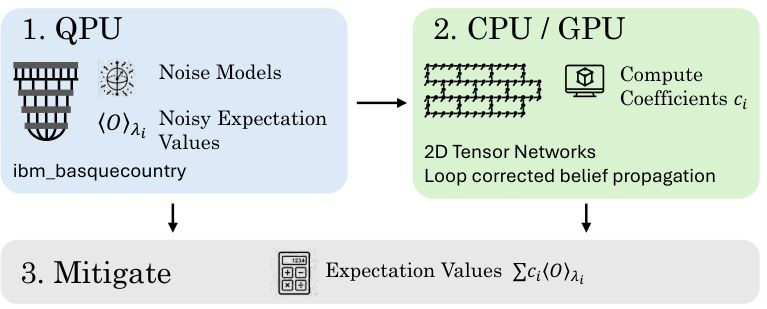
The workflow runs in three stages. A Pauli-Lindblad noise model is first learned from the quantum device, which also returns the noisy expectation values. Two-dimensional tensor networks, contracted with loop-corrected belief propagation, then compute correction coefficients on CPU and GPU. The two are combined into a mitigated expectation value.
The authors note that the quantities the tensor networks have to evaluate can be cheaper to compute than the observables themselves, which opens the method to systems where tensor networks alone would struggle. The workflow also incorporates Clifford rescaling and outputs an estimated error bar.
The experiment ran on 65 qubits arranged in a 3×3 heavy-hexagonal lattice on ibm_basquecountry, applied to a model of two-dimensional discrete time crystals that BasQ and IBM had studied earlier. A GPU implementation of the classical part of the workflow reached a speedup of up to 5.6 times.
Why a two-machine result is the shape we build for
The framing is the part we want to underline, because it is the premise of our own architecture rather than a caveat to it.
A quantum processor does not hand back a finished answer. What comes back has to be corrected, compared and placed in context before anyone can act on it, and that work happens on classical hardware. In this paper the classical side does the correcting. In VENETA WorldModel the classical side also does the comparing: a classical optimum is computed beside the quantum submission, and every result is reported with its backend, qubits, shots, depth and the gap between the two. An operator reading our screen is not asked to take the quantum number on faith. They are shown what the classical method found, what the quantum path found, and the distance between them.
The detail we read twice is the error bar. A mitigation technique that reports its own uncertainty alongside its answer is doing, at the level of an expectation value, what we try to do at the level of a decision: state the number and state how far it can be trusted. A figure without its conditions is not usable in an operations setting, whichever machine produced it.
That is also why a result like this one is good news for the work we deliver rather than a competing direction. Our products do not wait on a moment when a quantum processor outruns classical computing on an operations problem. They need the quantum contribution to be legible and trustworthy enough that a person can approve a decision that rests on it. Error mitigation is what moves a raw device result toward that bar, and a technique that leans on mature classical tooling — tensor networks, belief propagation, GPUs — moves it sooner than one waiting on hardware alone.
The hardware note is familiar to us for the same reason. The classical half of this workflow was worth putting on a GPU, and it ran up to 5.6 times faster for it. Our own simulation and baseline work runs on GPU nodes beside the quantum path on the same reasoning: in a hybrid workflow the classical side is not a placeholder, it is a substantial part of the computation and deserves real hardware.
Sources: Robertson et al., Lindblad Multiproduct Formulas, arXiv:2609.05024 (CC BY 4.0) · Jay Gambetta on LinkedIn. IBM, IBM Quantum and Qiskit are trademarks of International Business Machines Corporation. AMD is a trademark of Advanced Micro Devices, Inc.