

A site's conventions are not something a model can know in advance. Which queue a ticket belongs in, who an escalation goes to, when a maintenance window is taken — these differ by company and are often written down nowhere. A bigger model does not know them either. An operator has to correct them, and the correction only matters if it survives to the next session.
VENETA WorldModel's memory and self-improvement layer turns that correction into a rule and does not apply it until a person approves it. We measured whether the approval actually moves the outcome.
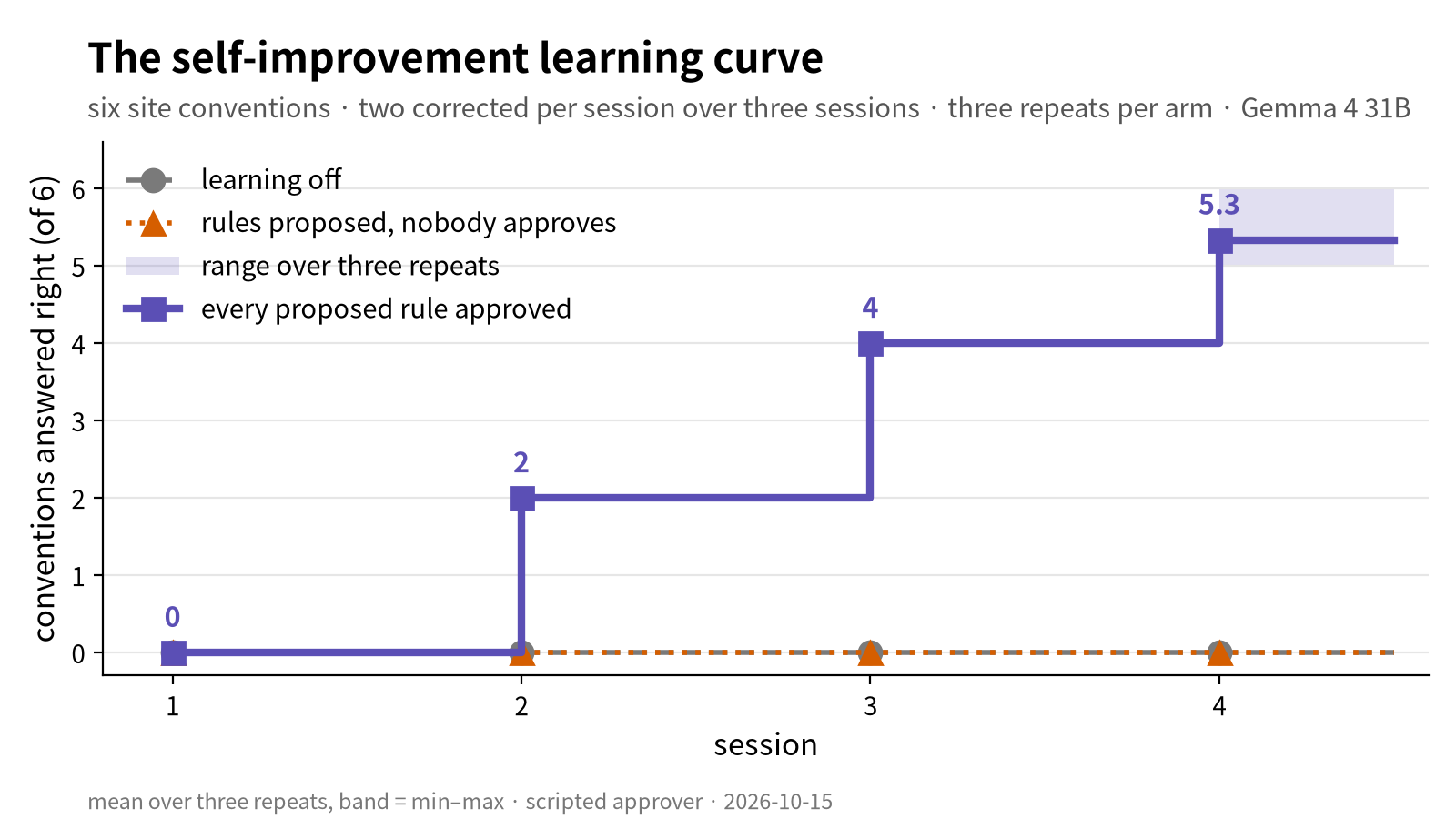
We took six site conventions a model cannot know in advance (a ticket queue, an escalation desk, a maintenance window and the like, each named by a synthetic codeword), started from an empty memory, and had the operator correct two of them per session over three sessions (the fourth session had no corrections, only questions). The layer turns each correction into one pending rule. With every proposal approved, the score climbs 2 → 4 → 5.3 of 6 at sessions 2, 3 and 4 (three repeats, range 5–6), one step after each session's approvals. With learning off, or with nobody approving, it is 0 of 6 in every session. Conditions: six synthetic conventions, one model (Gemma 4 31B, FP8), a scripted approver.
What moves the curve is the approval, not the proposal
The comparison that matters here is between the two arms that were learning.
The arm where nobody approved received the same corrections. In each of the three sessions that had corrections, the layer turned both corrections into pending rules, the same in the unapproved arm as in the approve-all arm. It still sat at 0 of 6 for all four sessions. The only difference between the two arms is the approval. Proposals piled up the same on both sides; one side had them approved.
The approval is where learning reaches the work. Without it, rules pile up as proposals and the number does not move. With it, you can trace which approval moved which number on the ledger, in a form you can show an auditor.
How the product works
- A correction becomes a candidate rule. What the operator fixes, the layer turns into one pending rule.
- Nothing applies before approval. Proposals, approvals, rejections and applications all land on an append-only ledger.
- We can show you the curve. Run files on request.
How to read it, and its limits
This is a curve on six synthetic site conventions, one model (Gemma 4 31B, FP8), with a scripted approver. It does not say the same shape appears in a customer's real operations; we have not measured that. Nor does it say the layer improves "on its own". It measures that a person's approval is the gate of the curve.
The note for this measurement, with its conditions, is on project veneta: The self-improvement learning curve.